
The 10-Minute Weekly CI Workflow for Founders
Most competitive intelligence routines die after three weeks because they demand 30 to 60 minutes a founder does not have. Here is a genuinely 10-minute weekly CI workflow, broken into four blocks, with the metrics to know it is actually working.
It is Monday morning. You have 47 unread Slack messages, a board update due Friday, and a feature your strongest competitor just shipped that you have not seen yet. You know you should be doing competitive intelligence. You also know "doing CI properly" is the kind of task that quietly slides off the calendar for six weeks at a time.
Most founder CI advice was written for full-time analysts. The "15-minute" routines that rank on page one of Google still demand RSS feeds, SWOT templates, manual benchmarking, and weekly review meetings. None of that survives contact with a founder's actual week, which is why you keep finding out about pricing changes from a customer on a sales call instead of from your own research.
This guide gives you a genuinely 10-minute weekly routine, broken into four blocks of two to three minutes each, that uses AI to compress the parts a human used to do manually. You will also get the metrics to know it is actually working, and a short list of failure modes to watch for after the first month.
Why Most Founder CI Routines Quietly Die
Open any "weekly competitive intelligence routine" article and count the minutes. The honest ones admit 30 to 60. The dishonest ones promise 15 and then ask you to maintain Google Alerts, RSS feeds, a SWOT spreadsheet, and a recurring review meeting. Either way, the math does not work for a founder running sales, product, and hiring at the same time.
The cost of skipping it is not abstract. Founders who stop tracking competitors miss pricing changes that should have triggered a counter-move, positioning shifts that should have updated the sales pitch, and feature launches that should have shaped the next sprint. By the time a customer mentions it on a call, you are already on the back foot, explaining instead of leading.
What changed in 2026 is the supply side. AI capability moved fast enough that the work a junior CI analyst used to do, scraping pages, classifying changes by type and importance, summarizing in plain language, is now something a model does in seconds. Recent releases have continued the trend. Claude Opus 4.7 lifted coding benchmark resolution by 13 percent over the prior model and solved tasks neither earlier model could (Source: Anthropic). The same trajectory has played out in classification and summarization, which are the two things a CI workflow actually needs.
The bottleneck has shifted. It is no longer the time spent gathering. It is the time spent deciding. A founder CI routine in 2026 should not be about being thorough. It should be about being decisive. Ten minutes a week, every week, beats a four-hour deep dive once a quarter, because the four-hour version never actually happens. If you want a refresher on the underlying discipline, see our complete guide to competitive intelligence for startups.
The 10-Minute Weekly CI Workflow, Block by Block
Run this on the same day every week. Monday morning works for most founders because it sets the agenda for the sprint. Pick a slot, defend it, and resist the urge to "do it properly later this week."
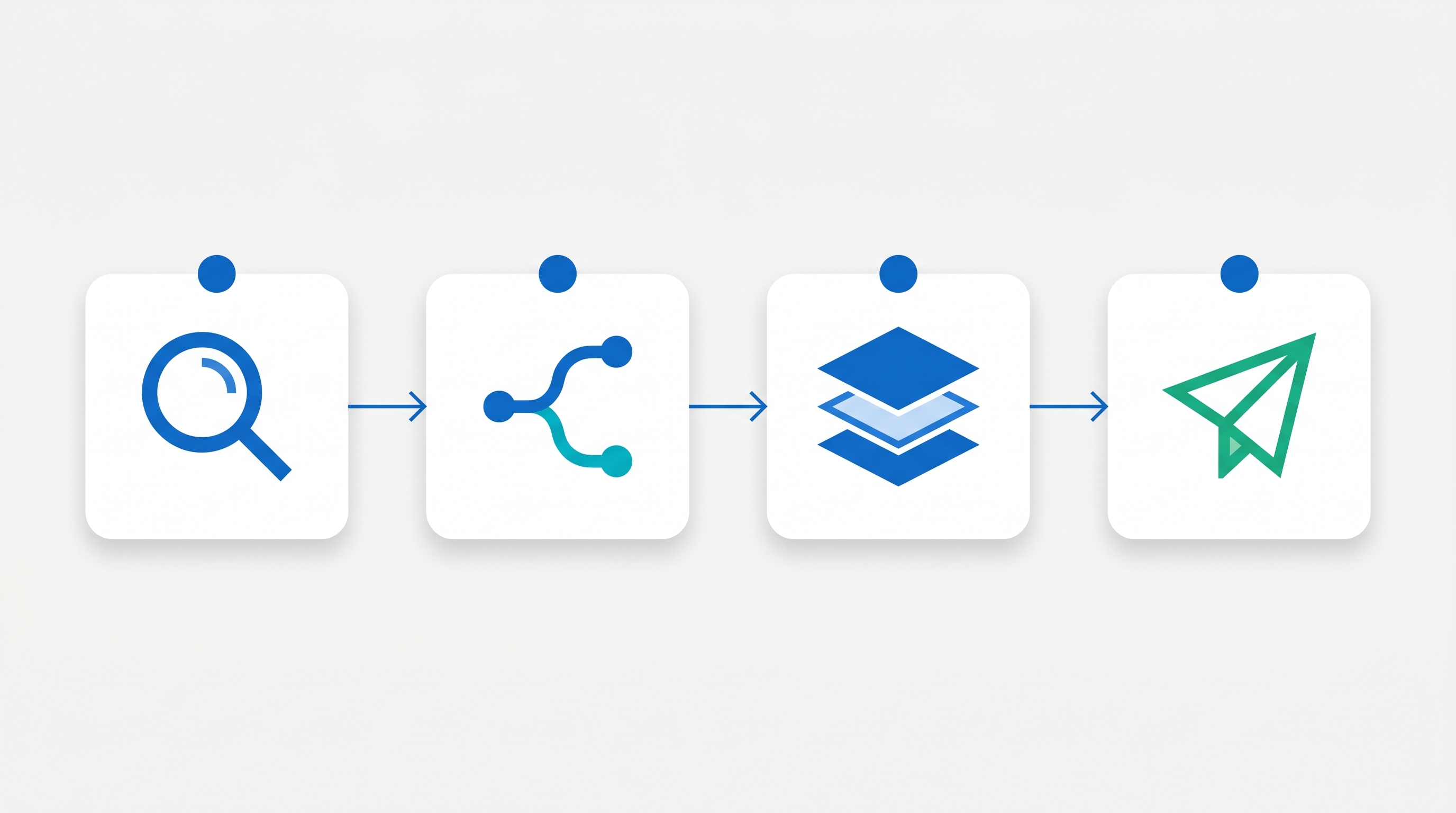
Block 1: Scan competitor changes (2 minutes)
Open your change feed, filter to high-importance items only, and read the headlines. You are looking for three things, in order: pricing moves, new features, and positioning shifts. Anything else can wait until next week or forever.
This block is two minutes only if your tool classifies importance for you. Without classification, you are reading every diff manually and the routine collapses on contact.
Block 2: Decide what matters (3 minutes)
For each high-importance change, answer one question: does this change what we ship, how we sell, or how we price? If yes, it goes on a short list. If no, it is logged and skipped. No analysis paragraphs, no Slack debates, no "let me think about this." A one-line decision is enough.
The point of Block 2 is that most weeks, the answer is no. That is fine. The discipline is in deciding, not in finding something profound to say.
Block 3: Update one battle card (3 minutes)
Pick the competitor that moved the most this week and update the relevant section of their battle card. Pricing, features, or objection handling. One section, not the whole card. Battle card debt is the silent killer of sales decks, and the only fix is one small update per week, every week.
After eight weeks of this, every battle card you own has been touched at least twice, and your sales conversations stop relying on stale screenshots from Q4.
Block 4: Send one signal (2 minutes)
Drop the week's top finding into your team Slack or your sales lead's DMs. One line, one link, one suggested action. "Acme dropped their entry tier from $49 to $29. Worth flagging on the next demo." That is the whole message.
This is what turns CI from a private hobby into team-wide leverage. CI that lives in your head changes nothing.
What to Track and What to Ignore
Every CI guide tells you to track everything: social media, hiring, press, reviews, traffic, SEO, ads, podcasts, conference appearances. For a founder, this is a recipe for noise, not signal. Competing routines in the founder space consistently overload weekly checklists with low-yield channels, then act surprised when readers stop following them.
Here is the 80/20 list, in priority order:
- Pricing page changes. Highest signal, lowest noise. A $10 bump or a new tier is a strategic statement.
- New features and product launches. These change your roadmap whether you like it or not.
- Positioning and homepage messaging shifts. These change your sales pitch and your demo script.
- Hiring patterns in product or sales. A sudden burst of senior hires in a category predicts the next move six months out.
The other rule worth internalizing is one competitor deep, three competitors shallow. Pick your single most direct competitor and track their pricing, features, and positioning in detail. Track two or three others at the headline level, just enough to catch a pricing move. Ignore everyone else until your context changes. A competitive map with 15 logos on it is a map, not a workflow.
For a longer breakdown of how the available tooling stacks up against this prioritization, see our review of the best competitive intelligence tools for startups in 2026.
The Tool Stack: What 10 Minutes Actually Requires
The 10-minute routine has a hard requirement: your tools have to do the gathering and classification. If they do not, the routine is fiction. The minimum viable stack has three pieces.
First, a change detection tool that classifies importance, so Block 1 is two minutes instead of twenty. Second, a battle card store your sales team can actually find, not a Notion doc that goes stale in a month. Third, a way to ask questions in plain English, like "did anyone change pricing this month?", instead of clicking through five dashboards.
What you do not need: SimilarWeb, Ahrefs, Semrush, Mention, Crayon, Klue, and a four-tool Zapier chain. Those are valid stacks for a CI manager with a quarterly budget and a research deck to produce. They are overkill for a founder running this in 10 minutes a week.
Here is the comparison that matters:
| Aspect | Manual stack (Alerts + RSS + spreadsheet) | AI-native stack (one platform) |
|---|---|---|
| Setup time | 4 to 8 hours initial config | Under 30 minutes |
| Weekly time required | 30 to 60 minutes | 10 minutes |
| Decisions surfaced per week | 0 to 1 (buried in noise) | 2 to 4 (pre-classified) |
| Battle card freshness | Updates rarely happen | One per week, by design |
| ROI horizon | Weeks before output is useful | First useful signal in week one |
How to Know It Is Working: Founder-Friendly Metrics
Forget DORA and enterprise CI dashboards. Founders need three signals, and you can track all three on a sticky note.
Decisions per month influenced by CI. Count the pricing changes, roadmap shifts, and sales pitch updates that you can trace back to a competitor signal. If the number is zero after eight weeks, the routine is theater. If the number is two or three per month, it is doing its job.
Surprise rate. How often do you learn about a competitor's move from a customer on a sales call instead of from your own routine? Lower is better. The first month, this number is usually high. By month three, it should be approaching zero. If it is not, you are tracking the wrong competitors or the wrong pages.
Battle card freshness. The date stamp on your most-used battle card. It should never be older than 30 days. If it is, Block 3 is being skipped, and your sales team is winging objection handling on stale information.
A realistic baseline for a founder running this routine for eight weeks: at least two product or pricing decisions traced to CI, surprise rate trending toward zero, and every active battle card refreshed within the last month. Teams using AI-native CI workflows often report faster feature iteration as a side effect, since pricing and feature signals feed directly into sprint planning instead of being discovered after the fact. Treat that as an observation from the field, not a hard benchmark.
If you want to try this without building the stack from scratch, SpyGlow's free tier covers two competitors and three pages each, which is enough to run the full 10-minute workflow for a month and see if it sticks before paying for anything.If you can name the last three product or pricing decisions you made because of CI, the routine is working. If you cannot name any, it is not.
Common Failure Modes, and the Fix
The routine is simple. The failure modes are predictable. Here are the four that kill it most often.
"I do it for three weeks then stop." The fix is to never schedule it as its own meeting. Tie it to an existing recurring meeting you already attend, like sprint planning or your weekly review. The 10-minute block sits inside an event you would never skip, so it stops being optional.
"I gather a lot but never decide anything." Block 2 is non-negotiable. If nothing makes the list this week, the week is done and that is fine. The trap is treating "no decision" as a failure of the routine instead of a feature of it. Most weeks should produce zero or one decision. A week that produces three is unusual.
"My battle cards keep going stale." Block 3 enforces one battle card update per week. Pick the competitor that moved the most, update one section, move on. The discipline is doing it every week, not making each update perfect. After eight weeks, you have made 16 small updates instead of one heroic refresh that never happened.
"My team does not see the output." Block 4 is the most important block, and it is the one founders skip first because it feels less productive than the gathering. CI that lives in your head changes nothing. The one-line Slack message to your sales lead is the entire point of the routine. If you only have time for one block this week, do Block 4 with last week's signal.
Frequently Asked Questions
How is competitive intelligence different from market research?
Market research is broad and periodic, usually quarterly or annual. CI is narrow and continuous. Market research tells you the size and shape of your market. CI tells you what your three closest competitors did this week and what to do about it. A founder needs both, but only CI belongs in a weekly routine. For the foundational definition, see our complete guide to competitive intelligence.
What is the best free tool for competitive intelligence?
For founders, the most useful free starting point is a tool that gives you AI-classified change detection on a small number of competitors, not a manual stack of Google Alerts and RSS feeds. Free tiers from current CI platforms now cover the basics that used to require a paid Mention or Crayon subscription. Start with two competitors and three pages each, and only upgrade when you outgrow that.
How often should a founder check on competitors?
Once a week, on the same day, in a 10-minute block. Daily checking creates anxiety without changing decisions, since most weeks have nothing important happening at any given competitor. Quarterly checking misses pricing and feature moves that should have changed your sprint. Weekly is the cadence that matches how often startups actually make decisions.
How do I track competitor pricing changes automatically?
Use a change detection tool that monitors specific page sections rather than entire sites. Section-level monitoring catches a $10 price bump on a single tier, where full-site diffing would bury the same change in CSS noise, header updates, and blog posts. Point the monitor at the pricing page, set the threshold to high importance, and let it page you when something moves.
Should solo founders bother with battle cards?
Yes, but keep them to one page each. Solo-founder battle cards exist for three audiences: you on a sales call, your future first sales hire, and your future self in six months when you have forgotten the details. They are not a polished sales enablement library. Update one card per week as part of the 10-minute routine and you will never have to do a painful from-scratch refresh.
Is AI-powered competitive intelligence accurate enough to trust?
For change detection and importance classification, yes. Modern models classify the difference between a hero copy tweak and a pricing change with high reliability, and the underlying capability has continued to improve through 2026 (Source: Anthropic). For strategic interpretation, treat AI output as a strong first draft, not a final answer. The 10-minute routine works because you are reviewing pre-classified signals in Block 1 and making the call yourself in Block 2.
The Bottom Line
Pick a day. Block 10 minutes. Run the four-block routine for four weeks and watch your surprise rate drop. The hardest part is not the workflow. It is committing to the same 10-minute slot every week instead of waiting for the imaginary afternoon when you will "do it properly."
If you want SpyGlow to handle the change detection and classification while you handle the decisions, start free. Two competitors, three pages each, no card required. That is enough to run the full routine for a month and decide if it has earned its slot in your calendar.
Sources
- Anthropic, Claude Opus 4.7 release notes, 2026. https://www.anthropic.com/news/claude-opus-4-7
What Is Competitive Intelligence? A Complete Guide for Startups
Learn what competitive intelligence really is, why it matters for startups, and how to build a system that turns competitor data into winning decisions.
Competitor MonitoringBest Competitive Intelligence Tools for Startups in 2026 (and Why Agentic Platforms Win)
A founder's guide to the best competitive intelligence tools in 2026, the three categories that matter, and why agentic AI platforms like SpyGlow change the game.
Ship the response, not just the read.
Free forever for your first two rivals. No credit card. Five minute setup.